Wedding colour scheme: how to choose your theme colours
Updated 26 October 2026 · Written by Lysela
A wedding colour scheme is two to four colours that set the mood of the day. Start with what is already fixed: the venue, the season and the flowers that are in bloom then. Pick one main colour, one or two supporting colours and an accent, and use them everywhere, from the save the date to the tables and the wedding website. Here is how to choose, wedding colour palettes by season, and how the theme carries into each detail.
Try it yourself, no account neededHow to choose wedding theme colours
Four colours is plenty. With more, the theme gets restless, and the flowers, tablecloths and clothes start to clash.
Look at the venue first
The walls, floor, wood and view are already there and cannot be changed. Pale stone, dark wood and greenery each call for different colours. Take a photo of the room and hold colour samples next to it.
Count on the season
The light and the flowers change through the year. What grows in your month is cheapest, and it looks like the place and the time.
Choose a main colour
It should show the most: on the tablecloths, in the bouquet and on the invitation. Pick one you will not tire of after ten months of planning.
Add one or two supporting colours and an accent
Supporting colours sit close to the main colour or are neutral, such as white, ivory and green. Use the accent sparingly, in a ribbon, a napkin or a wax seal.
Test them together
Put the colours side by side in daylight and in lamplight. A shade that looks soft on a screen can turn yellow or grey on the dinner table.
Wedding colour palettes by season
These are starting points. Swap one colour and see whether the mood holds.
| Season | Colour palette | Suits |
|---|---|---|
| Spring | Blush pink, sage, ivory | Light venues, gardens, cherry blossom and early greenery. |
| Early summer | White, pale blue, leaf green | Outdoor weddings, midsummer and long light evenings. |
| High summer | Lilac, yellow, linen | Country parties and meadow flowers. Yellow works best as an accent. |
| Autumn | Terracotta, mustard, sand | Farms and timber houses. Warm tones give a soft light in the evening. |
| Late autumn and winter | Burgundy, gold, deep green | Castles, manor houses and rooms with candles and heavy fabrics. |
| Winter | Navy, white, silver | Cool, bright rooms where one dark colour gives depth. |
Pastel, summer and other themes
A theme is more than colours. The mood comes from how the colours meet. Pastels turn light and airy with white and plenty of daylight, and sweeter with several shades in the same tone. A summer theme works best when the colours come from what is blooming, and a winter theme when there is something warm to lean on, such as candlelight and wood.
If you want a feeling rather than a colour range, think in materials: linen and dried flowers for something rustic, velvet and candles for something dark and evening, stone and brass for something clean and simple. The colours follow from the materials.
We want [mood], in [main colour] and [supporting colour], with [accent colour] as the detail.
Carrying the theme through the whole wedding
Save the date and invitation
This is where guests meet the theme first. Use the main colour on the card and the same typeface later. More on the wording is in the guides to the save the date and the wedding invitation.
Flowers
The bouquet and table arrangements take the main and supporting colours. Give the florist the colours and a photo of the venue, and they will suggest flowers that are in season.
Tables and printing
Tablecloths, napkins, place cards and the menu should look like one set. Read about the menu and the printed things in the menu and programme guide.
Clothes and dress code
The wedding party's outfits can take the supporting colour. If you want to ask guests for a colour, word it as a wish. See the dress code guide.
Hello, we are getting married on [date] at [venue]. Our colours are [main colour], [supporting colour] and [accent colour], and here is a photo of the room. Which flowers will be in season that suit them?
Dress code: [dress code]. If you would like to match the day, [colour] and [colour] would be lovely, but it is only a suggestion.
A wedding website in your wedding colours
The wedding website is often the first thing guests see of the theme, so it should have the same colours as the card and the tables. With Lysela you choose a style, and each style has its own typefaces and colours. A few examples: Classic is serif, ivory and gold, Rustic is italic, green and linen, Boho is soft serif, terracotta and sand, Velvet is italic, claret and gold, and Editorial is grotesque, navy and rust. You can see how they look on the example pages.
The save the date card can sit in an envelope that follows your colours. You choose the paper from champagne, linen, powder, rose, butter, sage and dove blue, and the wax of the seal from red, burgundy, rosé, sage, dove blue, navy and ivory. With Premium you set exactly the colours you want for background, text, accent and lines, and you choose from more typefaces than the style's own.
The dress code section can show a palette, so guests can see which colours suit. It starts from the page's colours, and you can change them.
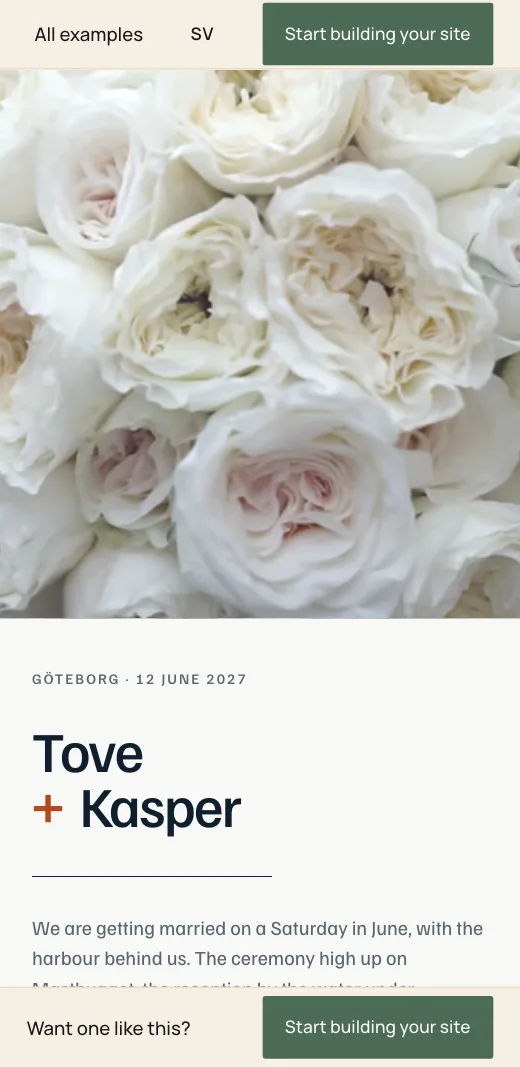
Your wedding website in your colour scheme
With Lysela you start from a style whose colours and typefaces suit your theme, in every tier. The save the date envelope gets the paper tone and seal you choose, and the dress code can show a palette for your guests. With Premium you set exactly the colours you want, and we can design the page around photos of your flowers and venue. You can try all of it on the page before you buy.
You pay once, SEK 795, SEK 1,795 or SEK 4,900 including VAT, and the site stays up for 12 months.
What usually goes on a wedding website, and what one costs, is in the checklist.
Frequently asked questions
How many colours should a wedding theme have?
Two to four is enough: a main colour, one or two supporting colours and an accent. More makes the theme hard to hold together.
How do you choose a wedding colour scheme?
Start from the venue, the season and the flowers in bloom then. Choose a main colour, add supporting colours and test them in daylight and in lamplight.
Do you have to have a theme at a wedding?
No. A theme helps with choosing flowers, tablecloths and printing, but a couple of colours you like is enough.
Can the wedding website have our own colours?
Yes. In every tier you choose a style with ready-made colours and typefaces. With Premium you set your own colours for background, text, accent and lines.