Wedding dinner: seated, buffet or long table, and how the evening runs
Updated 26 October 2026 · Written by Lysela
A wedding dinner is most often a seated three-course meal, but a buffet, long tables and family style work just as well. The choice depends on the venue, how many of you there are and how you want the evening to feel. Here are the pros and cons of each, the usual order of the dinner (with the speeches that are common at Swedish weddings), how to handle the menu and allergies, what the cost of the food depends on, wedding food ideas for a late-night snack and the questions to ask your caterer, with an email to start from.
Try it yourself, no account neededBuffet or seated wedding dinner?
Start with the venue and the guests. A tight room with many guests rarely suits a buffet, and a large room with open floor rarely suits a single long table.
| Format | Pros | Worth knowing |
|---|---|---|
| Seated dinner | Everyone is served together, and speeches and courses follow each other. Easy to take allergies into account. | Needs service at the tables and a seating plan. Guests stay seated for a long time. |
| Buffet | Guests choose for themselves and move around. Suits a group with many different wishes. | A queue forms, and speeches in the middle of the meal are harder. Label dishes with allergens. |
| Long table | Everyone sits close together, and the mood is easily homely. | It is hard to talk to someone across the table, and the room has to fit it. |
| Family style | Dishes are set in the middle of the table and shared. The food becomes a talking point. | You need table space, and a guest with an allergy needs their own bowl or plate. |
The order of a wedding dinner: how the evening runs
A timetable for the whole day is in the wedding day timeline guide. Give the toastmaster and the kitchen the same version, so the main course and the speeches do not clash.
Drinks and nibbles
Guests get something in their hand while you have your photographs taken. Let them mingle until the kitchen is ready.
Guests take their seats
The toastmaster asks everyone to go to the tables. A clear seating plan makes it quicker, and guests do not stand around looking for their name.
Starter and welcome speech
A short speech by a parent, a friend or one of you opens the dinner.
Main course and speeches
Put the speeches between courses rather than all in a row, so the food does not go cold.
Dessert, coffee and cake
This is where the couple often speak and the cake comes in. After that the dance floor opens.
Menu and allergies at the wedding dinner
Ask about allergies in your RSVP
The kitchen needs special diets in good time. If you ask in the RSVP, you avoid ringing round afterwards.
Offer a choice, not ten
Two or three main courses are enough, ideally with a vegetarian one. Then the kitchen knows how many portions of each to cook.
Think about the children
Children often eat something simpler. Ask the caterer about a children's menu or half portions.
Print the menu
A menu card at each place shows what is served and which dishes are vegetarian. There is more in the menu card guide.
Do you have any allergies or follow a special diet? Please write what applies, so the kitchen can prepare.
Choose your main course: [meat or fish dish], [fish dish] or [vegetarian dish]. Add a line describing each dish.
Wedding food: what the cost depends on
A price per person can only be compared once you know what it includes. Ask for a quote that shows each part separately.
Number of guests
The more guests, the more portions. The final number often has to be set some time before the wedding, so the RSVP deadline cannot sit late.
Format and staff
A seated dinner usually needs more service than a buffet. Ask how many people work, and until what time.
Number of courses and ingredients
Three courses cost more than two, and seasonal ingredients are often cheaper than ones that have to travel far.
Drinks
Drinks are usually priced separately. Ask whether wine and beer are handled by the caterer or by the venue.
The venue
Some venues have their own kitchen or require a certain supplier, others let you choose freely. Read the contract before you ask for quotes. Other parts of the budget depend on the same decision.
Late-night food at a wedding: ideas
In Sweden a late-night snack is common after midnight, or when the dancing has gone on for a couple of hours, and it makes the evening easier to end. Keep it simple and easy to eat standing up with one hand.
Sausages, bread and mustard
Quick to serve and works for a lot of guests.
Pizza
Order it, or bake it in a wood-fired oven if the venue has one. Include a vegetarian one and one without gluten.
Sandwiches and small pies
Can be made ahead and keep well on a table.
Soup in a cup
Warm on a cold night, and easy to make vegetarian.
Something sweet
Biscuits or buns with coffee and tea for those who stay.
Late-night food is served at [time] at [place]. There is a vegetarian option, and please tell us if you have an allergy.
Questions for the caterer, and an email to send
What is included in the price per person?
Starter, main course, dessert, coffee, bread, staff, table setting and washing up. Ask for it itemised.
How are allergies and children handled?
Ask for example dishes, and how they are labelled so the kitchen knows who gets what.
How many people work on site?
Ask how long they stay, and whether someone looks after the serving between speeches.
When must the number be final?
Ask also how late a couple of portions can be changed.
Can we taste the food?
Ask before you decide, ideally with the menu you have in mind.
What happens to leftover food?
Some caterers leave it, others take it with them.
Hello [name], We are getting married on [date] at [venue] with about [number] guests. We are thinking of [a seated dinner, a buffet, long tables or family style] with [number] courses and a late-night snack at [time]. Could you send a quote that shows the price per person for the food, staff and drinks separately? We would also like to know how you handle allergies and children, how late we can change the number, and whether we can have a tasting. Kind regards [names]
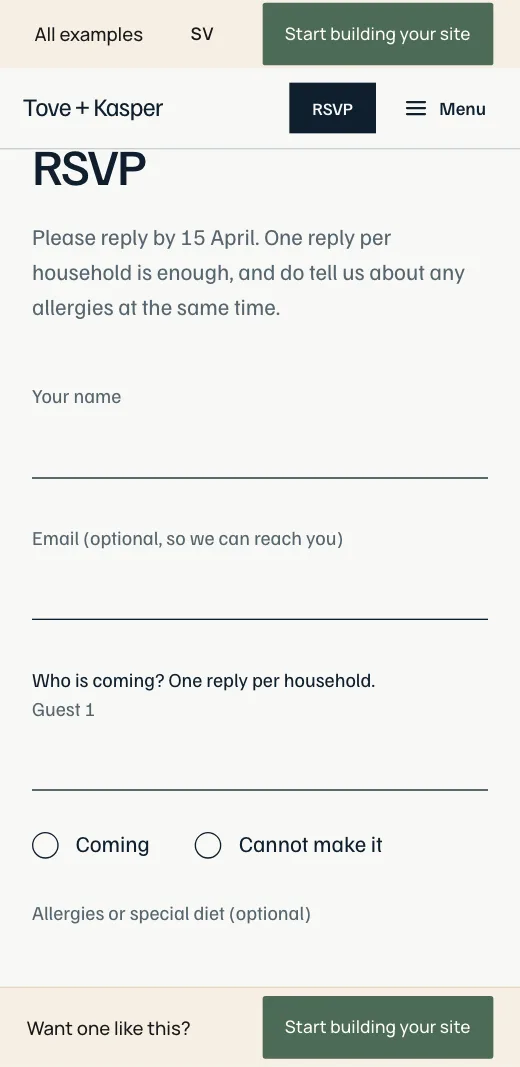
Allergies and menu choices in the RSVP
With Lysela, guests reply to the RSVP on their phones, with allergies and special diets, in every tier, with no app or account. You download the list as a file and hand it to the kitchen. From Plus you add a menu question where the guest chooses among your dishes, with a short description under each, and you see how many portions the kitchen should cook. You make place cards and menus in the print studio, and the kitchen gets a serving list per table.
You pay once, SEK 795, SEK 1,795 or SEK 4,900 including VAT, and the site stays up for 12 months.
What usually goes on a wedding website, and what one costs, is in the checklist.
Frequently asked questions
What is the order of a wedding dinner?
Drinks, guests taking their seats, a starter with a welcome speech, a main course with speeches, dessert with coffee and cake, and then dancing. Speeches are usually held between courses.
Buffet or seated dinner, which is better?
A seated dinner suits you if you want speeches between courses and everyone eating at the same time. A buffet suits a group with many different wishes and a venue with room to move.
When should the late-night food be served?
After midnight, or when the dancing has gone on for a couple of hours. Ask the toastmaster to announce it, so guests know where and when.
How do you ask guests about allergies and their choice of dish?
In the RSVP, in the same reply they send you. The kitchen then has everything in one place, and you avoid ringing round afterwards.