Wedding place cards: what to write and what size to make them
Updated 26 October 2026 · Written by Lysela
Write the guest's name on the card with the table underneath, so the guest knows where to sit. The card is either a folded tent that stands on the plate or a flat card, and you print it once the replies are in and the seating plan is settled, about a week before. Here is what goes on the card, the usual sizes, how to sort the cards on the day and how to mark meal choices and children.
Try it yourself, without an accountWhat do you write on a place card?
A place card sits at the seat. An escort card, or table sign, tells guests which table to go to. In Sweden both are often called bordskort, so check which one a supplier means.
First name or full name
The full name is safest when two guests share a name. Set the first name large and the surname small underneath, so it reads from a distance and is still unambiguous.
The table
The table number or name under the guest's name. A guest who has lost the seating chart still finds the right seat. With one long table you do not need it.
The meal choice
If you asked in the RSVP what guests want to eat, a small symbol can show the serving staff which dish is meant. More below.
Nothing else
The date and your names can sit at the bottom if the card is to be a keepsake. Otherwise the name is what should show, even in low light.
Place card template: wording to start from
Replace whatever is in square brackets.
[First name] [Surname] Table [number or name]
[First name Surname] Table [number or name]
[First name Surname] Table [number] [Symbol or word: meat, fish or vegetarian]
[First name] Table [number] Children's menu
Folded tent card or flat card, and what size?
A folded card stands by itself. Write the name on the side that faces the guest. A flat card needs a place card holder, a small clip or stand, or it falls over. Sizes and paper for the other printed items are in the guide to menu and place cards.
| Card | Size | Works when |
|---|---|---|
| Folded tent card | About 95 × 50 mm on the front, 95 × 100 mm unfolded | The card should stand on the plate or table without a holder. |
| Flat card | About 95 × 69 mm | The card is laid on the plate or placed in a holder. |
| Table sign | One A4 per sign, or folded as a tent | Guests should see which table it is from a distance. |
How to organise the place cards on the day
Cut and fold the evening before
Print a week ahead, once cancellations have come in, and cut and fold the day before. The morning is too late for a cutting mat and a ruler.
Sort into piles by table
One pile per table, with the table number on a note on top. Whoever lays the tables takes one pile at a time and does not have to search.
Alphabetical order for cards at the entrance
If guests pick up their cards from a table at the entrance, put them in alphabetical order, the same as on the seating chart. If the cards go on the plates, piles by table are enough.
Start at the top table
Lay the top table first and then table by table, so you see which seats are left over.
Keep a few blank cards
Someone turns up nobody expected, or a name is misspelt. Keep the file, so you can print a new card late.
Meal choices and children on place cards
If the kitchen has several dishes to choose from, ask guests in the RSVP. A small symbol on the card shows the serving staff who gets what, without anyone having to say it out loud. The kitchen also needs to know how many portions of each dish to cook for each table.
Allergies do not belong on the card, where everyone at the table sees them. Send them to the kitchen together with the table number.
Children get a card of their own like everyone else, with the first name and the table. If you have a children's menu, mark it on the card so the child gets the right plate. Count the children in your guest list, so nobody is left without a seat.
Making place cards yourself: printing at home
On the example sites you can see how guests look up their table on their phones, in addition to the cards.
Print a test sheet first
Printers take different paper thicknesses, and a sturdier paper stands better than ordinary copy paper. Try one sheet.
Cut on a cutting mat
A cutting mat and a knife give straighter edges than scissors, especially when you cut many cards.
Fold against a ruler
Run a pen tip or a pencil line along the fold before folding, so the crease is straight.
Or let a print shop do it
Save the cards as a pdf and take them along. A print shop can cut them for you.
Place cards in the print studio
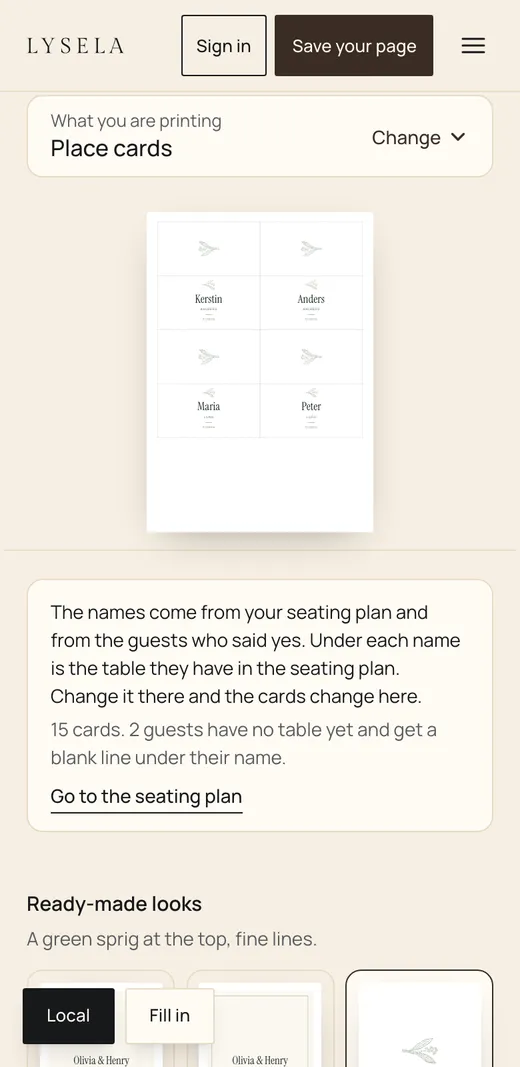
From Plus, you make place cards and table signs in the print studio. The names come from the seating plan and from guests who answered yes in the RSVP, and the table is printed under the name. If you change the seating plan, the cards change. You choose folded tent cards, four to an A4, or flat cards, eight to an A4 with cut lines, and whether the first name is large or the whole name set at one size. If the RSVP asks about the meal, a small symbol for the guest's choice can sit on the card, and the kitchen gets a serving list per table. The cards come in the seating plan's order, not alphabetically. You print at home or save a pdf for a print shop, and Lysela does not print anything for you. You can try the print studio before you buy, but printing needs Plus.
You start without an account and pay once, SEK 795, SEK 1,795 or SEK 4,900 including VAT, and the site stays up for 12 months.
What usually goes on a wedding website, and what one costs, is in the checklist.
Common questions
What is the difference between place cards and escort cards?
A place card sits at the seat with the guest's name. An escort card or table sign tells guests which table to go to.
Should you write the full name or just the first name?
The full name is safest. Set the first name large and the surname small, so it is easy to read and unambiguous when two guests share a name.
How do you put place cards in alphabetical order?
For a table at the entrance, put the cards in alphabetical order by the same name as on the seating chart. If they go on the plates, sort one pile per table instead.
Should children have place cards?
Yes, a card with the first name and the table. Mark the children's menu on the card if the child gets a different dish.