Wedding seating plan: how to do it and who sits where
Updated 1 October 2026 · by Ludvig Lindqvist Rovira, Lysela
Make the seating plan once most guests have replied to the RSVP, two to three weeks before the wedding. Start with the top table, then place the guests who need to sit close to or far from each other, and fill in the rest. Here are the usual rules, which of them you can ignore, and how guests find their seats.
Try it yourself, no account neededHow to make the seating plan, step by step
1. Start from the RSVP replies
Only seat those who said yes. With the replies in one list you are not counting chairs for guests who are not coming, see the RSVP guide.
2. Decide on the tables
Long tables, round tables or a mix. Ask the venue how many people fit and where the tables can go.
3. Start with the top table
The two of you, and those you want closest: parents, bridesmaids and groomsmen, or the toastmaster.
4. Seat the tricky ones first
Divorced parents, guests who do not get along and those who only know you. Once they are seated well, the rest is easy.
5. Fill in by group
Work, school, neighbours. Mix a little, but do not leave anyone alone among strangers.
6. Check against the replies the week before
Someone will have cancelled or fallen ill. Do a final check before the place cards are printed.
Which rules still apply?
| Rule | Does it still apply? |
|---|---|
| Alternate men and women | Optional. Many couples mix to keep conversation going, but it is not required. |
| Couples do not sit together | Common at formal dinners. Seat them opposite each other instead, so nobody feels forgotten. |
| The bride's father next to the groom's mother | An old order for the top table. Do what suits your family. |
| Children at their own table | Works for older children, with an adult nearby. Small children sit with their parents. |
| A place card at every seat | Useful with more than a couple of tables, so guests are not left searching. |
How do guests find their seats?
A seating chart at the entrance is the usual way: a sign with the tables and the names in alphabetical order. With a hundred guests, a queue forms in front of it. So put the seating plan on your wedding website too, where guests can look up their name on their phones while they mingle.
Welcome to dinner Find your name below, or search at [address].
The seating plan goes up the day before. Search for your name to see which table is yours.
Ask guests to take their seats at [time]. The seating chart is by the entrance and at [address].
What if someone cancels at the last minute?
Remove the chair rather than leave an empty place setting, if the venue has time. If the seat stays, move in a guest from a crowded table or leave it empty. Give the kitchen the new number as soon as you know. If the seating plan is on the wedding website, the change shows there straight away.
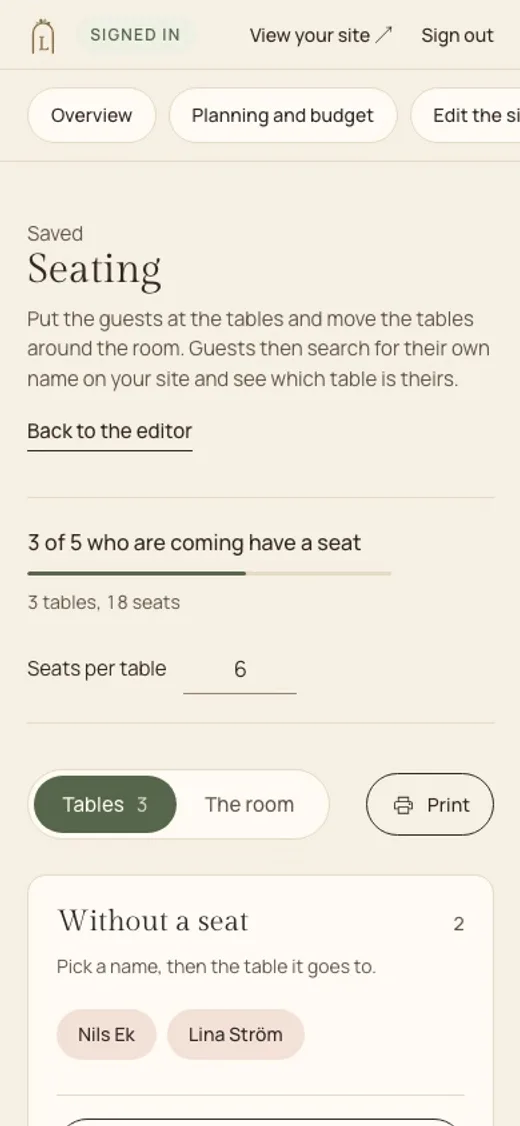
Seating plans with Lysela
With Lysela, from Plus, you move guests between tables on screen, with the names taken from the RSVP. Guests look up their seat on their phones on your wedding website, and you print the room plan to take to the venue. Place cards and table signs are made in the print studio, in your colours.
Common questions
When should the seating plan be done?
A week before the wedding, so place cards and the seating chart can be printed in time. Start once most guests have replied.
Do we need a seating plan?
No, but at a sit-down dinner with more than a couple of tables it makes things calmer. Without one, guests who know few people often end up last and scattered.
Who sits at the top table?
That is up to you. Most common today is the couple with their parents, or the couple with the bridesmaids, groomsmen and their partners.
Should couples sit next to each other?
At formal dinners couples are often seated opposite each other. At most weddings today couples can sit together if they want to.